
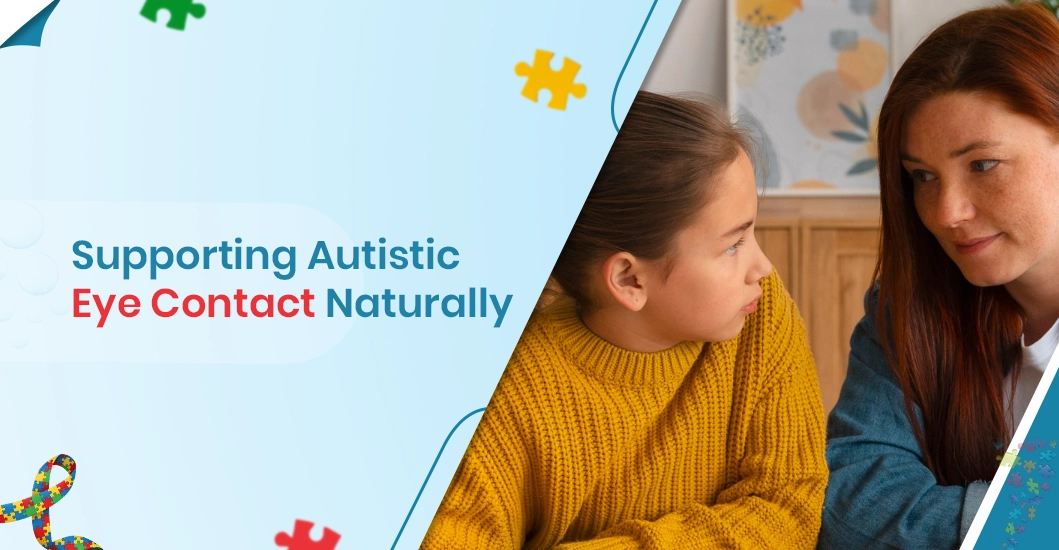
Most parents are concerned about their child with autism when the child does not maintain eye contact. Eye contact can be confusing or hurtful. However, it is important to understand that autistic children perceive eye contact differently.
Autistic children generally avoid eye contact due to cognitive processing differences in their brains. But it doesn’t mean lack of love or concern towards parents. For an autistic child, making eye contact is a challenging experience, as it can be overwhelming. However, this does not mean that the child is not paying attention; many autistic children are able to listen very carefully while gazing away. Parents who force eye contact with their autistic child increase the level of stress in their child’s life. What parents can do is to apply easy methods in daily life, e.g., sitting at the same level with a child, playing easy games, and being patient.
Why do autistic children avoid eye contact?
Many parents ask this question: “Why my child does speaks but is not maintaining eye contact? Why is this happening?” Yes, this is very common among some parents.
First, you have to understand that not being able to maintain eye contact is not a symbol of lacking love or affection for you. Autistic children behave differently because they process things slightly differently. That’s why their behaviour also seems different.
Generally, maintaining eye contact during a conversation is very common. But for children who have developmental issues, it seems to be uncomfortable because their brain processes it differently.
Does Eye Contact Really Matter for Communication?
No, not at all. Autistic children generally listen very carefully, but they fail to maintain eye contact. So parents must understand that maintaining eye contact is not the only thing to consider in communication with children.
Some children feel stressed or anxious when looking directly into the eyes while speaking. That’s why they look randomly or look at other things while speaking.
Why Forcing Eye Contact Can Do More Harm than Good
Many parents ask, “Should I force my autistic child to make eye contact?” The answer is No. you are not supposed to do that. Many parents forcefully ask their children to look at them. But by doing that, children may get more stressed and lose their confidence.
Instead of forcing your child to look at you, you can try some natural eye contact autism techniques during your daily routine. Understanding your child’s comfort level is the first step when learning how to improve eye contact in autistic children. You can take small actions and these can lead to good results for autistic children.
10 Gentle Strategies to Naturally Encourage Eye Contact
Sit according to their height: Sit on your knees or on a small stool. If your face is at their eye level, It will be very easy for them to look at you.
Keep the toys near your face: Hold their favourite toy or snacks close to your eyes. They will also see you while looking at that object.
Wait a while in the middle of the game: When playing a game of their choice, wait a while before the real fun comes. They will definitely look at you to ask “do it again”.
Appreciate even a small glance, don’t force it: Your kid saw you for a second. Smile lovingly or respond immediately. Also don’t say “look a little longer”.
Use a mirror while playing: Sit side by side in front of the mirror to play. They have no fear of looking directly at their own reflections.
Don’t put orders, just talk: Rather than ordering “look at me”, Say “I’m watching you” lovingly. It does not put any pressure on them.
Respect their will: If your kid’s face is turned aside, leave it. If forced, they will go away.
Make it a habit to say ‘hi’ in a small way: When going out or leaving near school, Shake hands saying a small ‘hi’ or ‘bye’. Don’t make a rule to look into the eyes for sure.
Use songs, rhymes: Pause while in the middle or singing songs or rhymes that children like. They look anxiously at you to see what will come next.
Observe the change by week, not by day: Don’t worry if they don’t see you for a day. Take two to three weeks and see if there is any improvement compared to the past.
Try to communicate with fewer words. Try talking while playing with toys. If they look naturally at you, compliment them and be joyful with them. Telling stories and singing activities often bring good results.
Activities Parents Can Try at Home
It is important not to force your child, but instead, you can follow useful eye contact autism tips for parents to encourage them naturally.
These games can help children to look at you without any pressure. They may get used to looking at you while playing.
Bubbles game (Bubble popping): Blow the bubbles close to your face, then wait a while. They look at you because they want bubbles again.
Peekaboo: You hide the face with the hands and showing “taa”. They naturally see your face and eyes.
Blowing games: Put a small feather or piece of paper on the table and blow them together. They will look at you to see when your turn will come.
Snack-based Games: Grab their favourite snack piece near your eyes and hold it for a few seconds and give it to them.
The important thing: In all these games there is no rule that children must look into the eyes. But, since they benefit from looking at you (finding a toy or playing), they start watching you on their.
What NOT to Do: Common Mistakes Parents Make
Don’t force them to “look at me” again and again: It’s like giving them an order. This will increase their tension and they will not be able to connect with you.
Holding the chin and trying to teach it by force: When they are already in trouble, turning their face like this will make them feel more uncomfortable.
Don’t compare with other children: “See, How your younger brother is talking, why don’t you do that?” Avoid using words like this. That will destroy their trust in you.
Don’t think that they’re not listening: The truth is even if they’re looking the other way, they might be listening to your words very attentively.
Don’t give punishment for not looking into eyes: Don’t grab their toys or stop the game because they don’t maintain eye contact. Because of this, they are afraid to spend time with you.
When should I visit a doctor?
If you suspect developmental issues in your children, then a doctor’s visit can help you to understand the whole picture. If you notice these things, then it’s better to consult a specialist.
Children not maintaining eye contact, not responding when their name is called, or doing the same thing again and again need more attention. If you observe these things, it is better to consult an expert in child development.
If the child has developmental difficulties, early detection can bring more benefits.
How ABA Therapy Supports Eye Contact Development
If you decide to try ABA therapy for eye contact autism, make sure the therapist focuses on your child’s comfort and emotional well-being. The modern ABA Therapy doesn’t work with a single goal of just “Maintaining Eye contact”. First they try to understand the cause why they are struggling to maintain eye contact.
A good therapist thoroughly notice the child first. He looks for the confusion around that. Is it due to Sensory Overload? Or are they Afraid to meet someone? Or not interested in speaking? After the keen assessment.
First they give them their favourite toys or things and build trust with them. After that make them look into the eyes slowly. Also, it is important whether this change is visible at home or not. There is no use.. if the improvement is seen only in the therapy room! The therapy is really successful when they can naturally look into the eyes of parents, siblings and even in new places outside.
“If your ABA therapist forces your child to make eye contact, it can harm their development. It is best to seek a second opinion from another therapist.”
Age-Wise Expectations: What to Realistically Aim For
Young children (1 to 3 years): When given their favourite snacks or toys, they look at your eyes for a few seconds. Just a few seconds, it’s a big deal to see it that way. Do not expect to see long periods at this age.
Pre-school children (3 to 5 years): At this age, they give small looks while playing. This is done especially at home and in a calm environment. At times like these, you can get used to them through small games without any pressure on them.
School-going children (6 to 10 years old): If there is good therapy support, they can to look into the eyes while wishing someone or talking about small things. But if they have to talk for a long time, they may find it a bit difficult.
Teenagers: By observing others, some teens learn how to fit into society, masking or practicing eye contact depending on the need.
Autistic children need a completely different approach to show love and communicate. So parents must not compare them with others. Instead, understand them with their abilities and be patient with their natural growth.
With the right guidance and understanding, children can often show good development with love and care.
We are with you
“No matter what doubts you have about your child’s growth, we are here to listen, understand, and show you the right path with love. Contact our team to share your problems. You are not alone in this journey, we will be with you.
Frequently Asked Questions
Should I force my kid to look into my eyes?
No, don’t do it at all. Forcing like that will increase their tension (stress), and they will not feel comfortable. It is better to get used to it slowly, in the way they like.
Why doesn’t my kid want to look into the eyes?
There are some reasons for that. Looking at our face at once and listening to our words may seem a little difficult to their brains. Some children experience unknown discomfort or fear when looking directly into their eyes. It is a matter of their nervous system and not stubbornness or mischief.
Does not look into the eyes means they don't listen to me?
No, not at all. Most children with autism can understand our words better when they are looking the other way. Because the decrease in the effort of looking into the eyes, they can put their mind completely on listening.
Will this habit change as they grow?
Yes, it may change. Teaching without any stress and love can change many children. However, some people do not like to look straight into the eyes even after growing up.