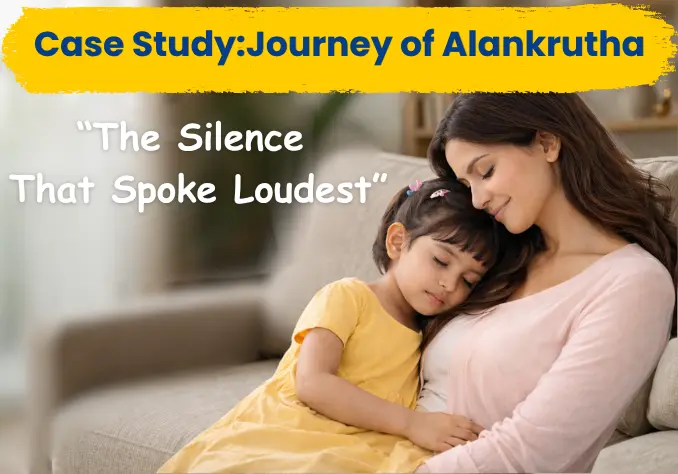
Alankrutha was not like the other children, but no one noticed it in time.
At 12, she sat quietly in her 6th standard classroom, often gazing out the window. She wasn’t lost; she was deeply absorbed in a world only she understood. Teachers called her “quiet,” relatives said she was “shy,” and neighbours believed, “She will grow out of it.”
But she didn’t.
Early Childhood: The Missed Signs
Alankrutha was born a healthy child. Her parents remember her as calm, almost too calm. She rarely cried, rarely demanded attention, and preferred being alone.
At the age when most children begin to babble and respond to their names, Alankrutha stayed in her own rhythm.
- She avoided eye contact.
- Didn’t respond consistently when called.
- Preferred lining up her toys instead of playing with them.
- Showed no interest in social games.
Her parents assumed, “She is just different.”
And that assumption cost them time.
According to medical understanding, early signs of autism often include limited eye contact, delayed response, and repetitive behaviours. In Alankrutha’s case, though, these signs were overlooked.
The Turning Point: Age 7
It was in her 2nd class that the first serious concern arose.
Her class teacher noticed something unusual.
“Alankrutha doesn’t interact with other children,” she told her parents.
“She repeats the same words, and she gets extremely disturbed if routines change.”
The situation at home was also growing increasingly difficult:
- She would have emotional breakdowns over small changes.
- She spoke in repetitive phrases (echolalia).
- She struggled to express emotions.
- She avoided physical affection.
Her parents, now anxious and confused, decided to seek medical help.
The First Consultation with Dr. A.M Reddy
The consultation room was quiet, except for Alankrutha, who kept spinning the wheels of a toy.
Dr. A.M Reddy observed quietly.
He didn’t interrupt.
He didn’t rush.
Instead, he watched.
Then he gently called her name.
No response.
He tried again, this time using a gentle tone.
She briefly looked… then looked away.
After a series of behavioural observations and interaction tests, Dr. A.M Reddy turned to her parents.
“Your child is not distant… she processes the world differently.”
Those words changed everything.
Diagnosis: The Reality Sets In
After a detailed assessment, Alankrutha was diagnosed with Autism Spectrum Disorder (ASD), a neurodevelopmental condition that affects communication, behaviour, and social interaction.
Her parents broke down.
Not because of the diagnosis,
But because of the delay.
“Could we have helped her earlier?” her mother asked.
Dr. Reddy replied softly:
“Yes. But it’s not too late.”
The Emotional Struggle
The journey that followed was not easy.
Her parents faced:
- Guilt for late identification
- Social stigma and misunderstanding
- Emotional exhaustion
- Financial strain for therapy
Relatives questioned them.
Neighbours judged them.
But her parents chose to stand strong.
Because for the first time, they understood her.
The Transformation Journey
With structured intervention:
- Behavioral therapy
- Speech therapy
- Special education support
Slowly, small changes began.
At first, it was just eye contact.
Then, a smile.
Then, one day,
She said, “Amma.”
That one word erased years of pain.
Current Status (Age 12)
Today, Alankrutha:
- Attends 6th class
- Can communicate basic needs
- Shows emotional attachment to her family
- Still prefers routines but adapts slowly.
She may not be “like others.”
But she is uniquely herself.
And that is her strength.
Therapy Journey of Alankrutha: Step-by-Step Progress
Alankrutha’s therapy was a gradual process, guided by Dr. A.M Reddy, who developed a personalised intervention plan. Speech therapy enabled her to progress from single words to meaningful sentences. Behavioural therapy helped her manage change and adapt to routines more easily.
Sensory integration therapy helped reduce her sensitivity to sounds and surroundings, making daily situations more manageable. Progress varied, but consistent effort led to steady gains in confidence and independence. Over time, these therapies led to significant improvements in her communication, behaviour, and emotional regulation.
Social Interaction: Alankrutha’s First Friendship
Forming friendships was challenging for Alankrutha. She preferred solitude and struggled with social cues and conversation. For some time, she observed peers without joining in, which concerned her parents about her ability to connect with others.
This changed when a classmate approached her with patience and understanding. Their friendship, based on comfort and acceptance, encouraged Alankrutha to engage, share, and participate in interactions. This relationship significantly boosted her social confidence and demonstrated that, with appropriate support, meaningful connections are possible.
Academic Challenges and Learning Style of Alankrutha
School presented significant challenges for Alankrutha. Others often misinterpreted her difficulties as disinterest or low ability, when the classroom environment did not align with her learning style. She struggled with verbal instructions, group discussions, and unexpected changes, which gradually diminished her confidence and participation.
When her teachers and family recognised her learning style, they made adjustments such as providing clear instructions, visual aids, and consistent routines. In these structured settings, Alankrutha demonstrated strong focus and excelled in tasks requiring attention to detail and visual thinking. Her experience highlights the importance of adapting education to the individual child.
Role of Family Support in Alankrutha’s Progress
Her family supported Alankrutha’s progress at every stage. Initially, her parents felt uncertain due to a late diagnosis and limited information. As their understanding of autism grew, they shifted from reacting with worry to responding with intention. They adjusted their communication, maintained a calm and predictable home, and ensured she always knew what to expect.
Her mother became a key source of support, closely observing Alankrutha’s behaviours, identifying triggers, and celebrating small achievements. The family shifted from comparisons to acceptance, creating a supportive environment that fostered her growth. Alankrutha’s progress demonstrates the impact of family acceptance and involvement.
Strengths and Hidden Talents of Alankrutha
Initially, attention centred on Alankrutha’s challenges. Over time, her strengths became evident. She demonstrated exceptional memory and attention to detail, and when engaged, produced work marked by both precision and creativity.
Art became Alankrutha’s primary means of expression, allowing her to communicate beyond words. Her drawings offered insight into her perspective and gained recognition in school competitions, which boosted her self-esteem. Her journey illustrates that children with autism often possess unique talents that can flourish with encouragement and opportunity.
Therapy Journey of Alankrutha: Step-by-Step Progress
Alankrutha’s therapy was a gradual process, guided by Dr. A.M Reddy, who developed a personalised intervention plan. Speech therapy enabled her to progress from single words to meaningful sentences. Behavioural therapy helped her manage change and adapt to routines more easily.
Sensory integration therapy helped reduce her sensitivity to sounds and surroundings, making daily situations more manageable. Progress varied, but consistent effort led to steady gains in confidence and independence. Over time, these therapies led to significant improvements in her communication, behaviour, and emotional regulation.
Social Interaction: Alankrutha’s First Friendship
Forming friendships was challenging for Alankrutha. She preferred solitude and struggled with social cues and conversation. For some time, she observed peers without joining in, which concerned her parents about her ability to connect with others.
This changed when a classmate approached her with patience and understanding. Their friendship, based on comfort and acceptance, encouraged Alankrutha to engage, share, and participate in interactions. This relationship significantly boosted her social confidence and demonstrated that, with appropriate support, meaningful connections are possible.
Academic Challenges and Learning Style of Alankrutha
School presented significant challenges for Alankrutha. Others often misinterpreted her difficulties as disinterest or low ability, when the classroom environment did not align with her learning style. She struggled with verbal instructions, group discussions, and unexpected changes, which gradually diminished her confidence and participation.
When her teachers and family recognised her learning style, they made adjustments such as providing clear instructions, visual aids, and consistent routines. In these structured settings, Alankrutha demonstrated strong focus and excelled in tasks requiring attention to detail and visual thinking. Her experience highlights the importance of adapting education to the individual child.
Role of Family Support in Alankrutha’s Progress
Her family supported Alankrutha’s progress at every stage. Initially, her parents felt uncertain due to a late diagnosis and limited information. As their understanding of autism grew, they shifted from reacting with worry to responding with intention. They adjusted their communication, maintained a calm and predictable home, and ensured she always knew what to expect.
Her mother became a key source of support, closely observing Alankrutha’s behaviours, identifying triggers, and celebrating small achievements. The family shifted from comparisons to acceptance, creating a supportive environment that fostered her growth. Alankrutha’s progress demonstrates the impact of family acceptance and involvement.
Strengths and Hidden Talents of Alankrutha
Initially, attention centred on Alankrutha’s challenges. Over time, her strengths became evident. She demonstrated exceptional memory and attention to detail, and when engaged, produced work marked by both precision and creativity.
Art became Alankrutha’s primary means of expression, allowing her to communicate beyond words. Her drawings offered insight into her perspective and gained recognition in school competitions, which boosted her self-esteem. Her journey illustrates that children with autism often possess unique talents that can flourish with encouragement and opportunity.
Therapy Journey of Alankrutha: Step-by-Step Progress
Alankrutha’s therapy was a gradual process, guided by Dr. A.M Reddy, who developed a personalised intervention plan. Speech therapy enabled her to progress from single words to meaningful sentences. Behavioural therapy helped her manage change and adapt to routines more easily.
Sensory integration therapy helped reduce her sensitivity to sounds and surroundings, making daily situations more manageable. Progress varied, but consistent effort led to steady gains in confidence and independence. Over time, these therapies led to significant improvements in her communication, behaviour, and emotional regulation.
Social Interaction: Alankrutha’s First Friendship
Forming friendships was challenging for Alankrutha. She preferred solitude and struggled with social cues and conversation. For some time, she observed peers without joining in, which concerned her parents about her ability to connect with others.
This changed when a classmate approached her with patience and understanding. Their friendship, based on comfort and acceptance, encouraged Alankrutha to engage, share, and participate in interactions. This relationship significantly boosted her social confidence and demonstrated that, with appropriate support, meaningful connections are possible.
Academic Challenges and Learning Style of Alankrutha
School presented significant challenges for Alankrutha. Others often misinterpreted her difficulties as disinterest or low ability, when the classroom environment did not align with her learning style. She struggled with verbal instructions, group discussions, and unexpected changes, which gradually diminished her confidence and participation.
When her teachers and family recognised her learning style, they made adjustments such as providing clear instructions, visual aids, and consistent routines. In these structured settings, Alankrutha demonstrated strong focus and excelled in tasks requiring attention to detail and visual thinking. Her experience highlights the importance of adapting education to the individual child.
Role of Family Support in Alankrutha’s Progress
Her family supported Alankrutha’s progress at every stage. Initially, her parents felt uncertain due to a late diagnosis and limited information. As their understanding of autism grew, they shifted from reacting with worry to responding with intention. They adjusted their communication, maintained a calm and predictable home, and ensured she always knew what to expect.
Her mother became a key source of support, closely observing Alankrutha’s behaviours, identifying triggers, and celebrating small achievements. The family shifted from comparisons to acceptance, creating a supportive environment that fostered her growth. Alankrutha’s progress demonstrates the impact of family acceptance and involvement.
Strengths and Hidden Talents of Alankrutha
Initially, attention centred on Alankrutha’s challenges. Over time, her strengths became evident. She demonstrated exceptional memory and attention to detail, and when engaged, produced work marked by both precision and creativity.
Art became Alankrutha’s primary means of expression, allowing her to communicate beyond words. Her drawings offered insight into her perspective and gained recognition in school competitions, which boosted her self-esteem. Her journey illustrates that children with autism often possess unique talents that can flourish with encouragement and opportunity.
Understanding Autism Spectrum Disorder (ASD)
What is Autism Spectrum Disorder? (ASD Meaning & Definition)
Autism Spectrum Disorder (ASD) is a condition that affects how people communicate, behave, and interact with others. It is not a disease, but a lifelong difference that starts in early childhood and continues into adulthood. People with autism often see and experience the world in their own way, which can shape how they express themselves, form relationships, and react to their surroundings.
The term “spectrum” is used because autism looks different for everyone. Some people need a lot of support each day, while others can live on their own with little help. Since everyone’s experience is unique, it’s important to understand and support each person as an individual. Seeing autism as a difference, not a limitation, helps create a more inclusive and supportive community.
Early Signs and Symptoms of Autism in Children
Common symptoms include:
- Lack of eye contact
- Delayed speech or language loss
- Not responding to name
- Repetitive behaviours (hand-flapping, lining objects)
- Difficulty understanding emotions
These signs usually show up before age 3, but sometimes, as with Alankrutha, diagnosis can happen later.
Children with autism may also prefer playing alone and show less interest in social activities. They might find it hard to read facial expressions, tone of voice, or social cues, which can make
it difficult to talk with others. Many children with autism like routines and can get upset if those routines change. They may also be sensitive to sounds, lights, textures, or smells. Noticing these early signs can help families and teachers identify autism sooner and start support early.
Causes of Autism Spectrum Disorder
There is no single known cause, but research suggests:
- Genetic factors
- Environmental influences
- Brain development differences
Importantly, vaccines do NOT cause autism.
Research shows that autism happens because of a mix of genetics and environmental factors that affect early brain development. Some genes can make a person more likely to have autism, and things that happen before or soon after birth can also play a role. People with autism often have differences in the brain regions that control communication and behaviour. Learning about these causes helps raise awareness and clear up myths or misunderstandings that can lead to fear or stigma.
Why Late Diagnosis Happens in Autism
Some children are diagnosed late due to:
- Mild or hidden symptoms
- Lack of awareness among parents/teachers
- Social masking (especially in girls)
- Mislabeling as shyness or introversion
Late diagnosis can delay intervention, but improvement is still possible.
Often, children find ways to hide their symptoms, especially at home or school. Girls may copy others’ social behaviours to fit in, making their challenges harder to spot. In places where people know less about autism, early signs might be missed or mistaken for personality traits. Even if a child is diagnosed late, they can still make good progress with the right support and interventions.
Types and Levels of Autism (Spectrum Explained)
ASD is categorised based on support needs:
Level 1: Needs minimal support
Level 2: Needs moderate support
Level 3: Needs substantial support
Each child presents uniquely, and no two cases are identical.
These levels help experts decide how much support a child needs with communication, behaviour, and daily life. But autism is not the same for everyone, and people can have different strengths and challenges. For example, one child might be good at thinking and learning but find social situations hard, while another might need help with talking but be very creative. The idea of a spectrum reminds us that everyone with autism is unique and deserves support that fits their needs.
Diagnosis of Autism in Children and Adolescents
Diagnosis involves:
- Behavioral observation
- Developmental assessments
- Speech and social evaluation
There is no single lab test; diagnosis is clinical and multidisciplinary.
Diagnosing autism usually involves a team of specialists who examine a child’s development and behaviour. Parents are important in this process because they can share details about how their child grows, communicates, and interacts every day. Doctors often use special checklists and tests to help them decide. Early screening has helped more people learn about autism, but experts still need to make the final diagnosis. Getting the right diagnosis early is important because it helps families start the best support and plan for the future.
Treatment Options and Therapies for Autism
While there is no cure, the following effective interventions are available:
- Behavioural therapy (ABA)
- Speech and language therapy
- Occupational therapy
- Sensory integration therapy
Early intervention significantly improves outcomes.
These therapies help children communicate better, improve their behaviour, and learn important life skills. Behavioural treatment teaches good habits and helps with difficult behaviours. Speech therapy works on talking and understanding others. Occupational therapy helps kids with daily tasks and builds their independence. Sensory integration therapy helps with sensitivities to things like sounds or textures. Starting early, being consistent, and making a plan that fits each child’s needs are all important. Families also play a big part in helping children make progress outside of therapy.
Living with Autism: Support, Strengths & Long-Term Outlook
Children with autism may:
- Have exceptional memory or skills
- Excel in art, music, or mathematics
- Develop independence with support
With the right environment, they can lead fulfilling lives.
Living with autism means learning and growing with support from family, teachers, and the community. Many people with autism have special strengths, like being creative, noticing details, or focusing deeply on things they enjoy. With the right support and chances to take part, they can make friends, learn new things, and succeed in life. Accepting and valuing differences helps people with autism reach their goals and live with dignity.
Early Intervention in Autism: Why Timing Matters
Early intervention is crucial for Autism Spectrum Disorder. The first years of life are when the brain is most receptive to learning and change, making timely support essential. Early identification allows therapies such as speech, behavioural, and occupational therapy to produce meaningful improvements in communication, social interaction, and daily functioning.
Children who receive early support often achieve greater progress in language, emotional regulation, and independence. While later intervention can still be effective, early action provides a significant advantage. Early intervention also equips parents with the knowledge and tools needed to support their child effectively.
Autism in Girls vs Boys: Key Differences and Challenges
| Aspect | Autism in Girls | Autism in Boys |
| Symptom Visibility | Symptoms are often subtle and less noticeable | Symptoms are usually more visible and easier to identify |
| Social Behavior | More likely to imitate others and blend in socially (social masking) | Less likely to mask; social difficulties are more apparent |
| Diagnosis Timing | Frequently diagnosed late due to hidden traits | Often diagnosed earlier due to clear behavioural signs |
| Repetitive Behaviors | Less obvious or socially acceptable (e.g., intense interest in books, art) | More noticeable repetitive actions (e.g., hand-flapping, lining objects) |
| Emotional Expression | Tend to internalise emotions, leading to anxiety or distress | More likely to externalise behaviours (e.g., hyperactivity, outbursts) |
| Social Interaction | May appear socially engaged but struggle internally | Clearly struggle with social interaction and communication |
| Interests | Interests may align with socially accepted norms, making them less noticeable | Interests may be more restricted or unusual |
| Risk of Misdiagnosis | Higher risk due to masking and subtle presentation | Lower risk due to more evident symptoms |
| Awareness Requirement | Requires more sensitive and observant evaluation | Easier to identify with general awareness |
Role of Parents in Managing Autism Effectively
Parents play a central role in a child’s development with autism. Their patience, involvement, and understanding have a profound impact beyond what therapy alone can achieve. A consistent, clear, and supportive home environment fosters growth, and parents are essential in applying therapeutic strategies to daily life.
Parents who educate themselves about autism, participate in therapy, and apply the techniques they learn at home greatly enhance intervention outcomes. Emotional support is equally important. When parents respond with empathy, they build trust and facilitate communication. Informed and involved parents can positively influence the entire course of their child’s development.
Importance of Special Education and Inclusive Learning
The education a child with autism receives is critical to their future. Special education programs recognise diverse learning needs and focus on communication, behaviour management, and life skills. Individualised Education Plans (IEPs) further tailor instruction to each child’s strengths and challenges, ensuring an appropriate educational approach.
Inclusive education, which integrates children with autism into mainstream classrooms, can be highly beneficial with appropriate support. It promotes social interaction, confidence, and a sense of belonging. Teachers who understand developmental differences are essential in fostering an inclusive classroom. Optimal outcomes result from balancing specialised support with inclusion.
Communication Challenges in Autism and How to Improve Them
Communication is a core challenge in autism. Some children are non-verbal, while others have difficulty using language effectively. Expressing needs, understanding social cues, and maintaining conversations can be difficult, even if these struggles are not always apparent.
Improving communication requires structured therapy and consistent practice. Speech therapy develops verbal skills, while visual aids, sign language, or communication devices provide alternative methods for those needing extra support. Simple, clear, and consistent communication at home reinforces therapy. With time and effective strategies, children can develop meaningful connections.
Conclusion
Alankrutha’s story shows that autism is not a limitation but a different way of seeing the world. Her late diagnosis reminds us how important awareness is, especially for girls whose symptoms can be harder to notice. Thanks to Dr. A.M Reddy and her family’s support, she learned to grow, communicate, and discover her strengths.
The main message is clear: understanding and early support can make a big difference. When we choose empathy over judgment, children with autism are not just supported, they are given the chance to thrive.